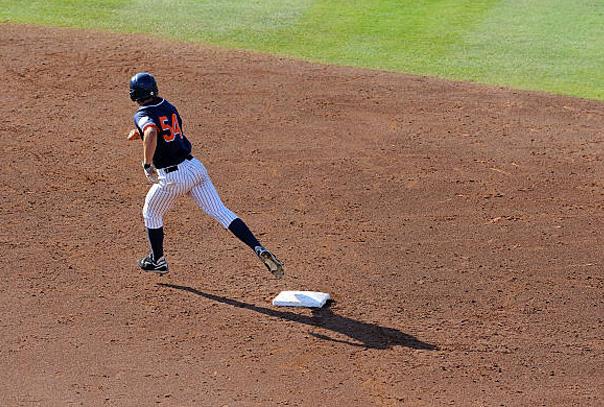
Last issue, we discussed how to create a buy-in to base running; fail to use it as a weapon and you will miss out on a distinct competitive advantage. The more you educate your players about how baserunning is far more about details and decisions than it is about pure speed, the more they’ll understand that they, too, can become great baserunners—even if they aren’t fast!
The first detail is non-negotiable: EFFORT. It takes no ability to run hard. The fastest guy in the world and the fattest guy in the world don’t run the same speed, but they can both run with the same effort. When someone is dogging it, there is no sense of urgency to make a play on defense, but when someone is busting it, the same play becomes a lot harder.
When everyone pays attention to the details, your group will yield impressive dividends. Let’s go around the horn:
Home to First—Turns and Touches
There are three ways to get down the line: straight through, a “banana angle,” and the “question mark.” On any ball in the infield, the batter-runner runs straight through the front part of the base, because it’s quicker to run 90’ than 91’, and one foot might be the difference between “out” or “safe.” On hits in the air, the batter should create a “banana” angle early out of the box, gradually working towards the inside corner of first, with the right foot. The early angle allows the runner to speed up towards first should there be a chance for “two,” and the right foot keeps the body mass in a more direct line to second. The “question mark,” which slows you down as you create a late angle, is only appropriate on balls that may get caught, but ultimately get to the outfield.
First to Second—Primary and Secondary Leads
Know your lead by knowing your steps—when you are consistent with how you take your lead, you can keep your eyes on the pitcher, as you don’t have to look back to check where you are. Take your lead from the back of first, this puts you in a more direct line to second should you steal, and makes it easier to round second. For the secondary, you want to land from your shuffle as the catcher catches the ball so you can get a good jump when the ball is put in play.
Second to Third—“Out” Rules
On second, the details are as simple as knowing the outs. With no outs, we should be thinking “tag” on any routine-to-deep fly ball to the outfield that has a chance of being caught. Our priority here is “get to third,” so if an outfielder makes a circus catch, you’re still in position to tag and get to third with one down. On the same fly ball with one out, the baserunner should read and extend, as the goal now is to score. Same with two outs, the thought is to score, which comes back to effort—when you go as hard as you can, you’re giving yourself the best chance to score.
With two outs and two strikes, think “swing;” when that bat goes, you go. If it’s a swing and miss, the inning is over, and if the ball is in play, you have a running start!
Third to Home—Contact Play
The contact play is one that you see in baseball often, where runners at third go on any ball in play on the ground. To the untrained eye, it seems amazing to see a runner score on a routine grounder with the infield “in,” but to those who know the details, it’s not as surprising.
The contact play is about primary lead distance, secondary lead timing, and anticipation. Get off as far as the third baseman allows with your primary lead—the further away he is, the bigger the lead—every inch matters. Whether a walking or shuffling lead, we are looking to land the right foot down in the hitter’s contact area, ahead of when the catcher would receive the ball. We must expect every single pitch to be put in play, it’s the only way a “contact play” has a chance to work. When done right, you’ll get doubled off on a line drive—that’s part of the risk—because the read comes after the break. But you also have a great chance of scoring on a ground ball!
Coaches often talk about having a complete team, able to win games in different ways. While a team that only hits, pitches, and plays defense might win a lot of games, every team can be better if they can improve in this one part of the game that many neglect.