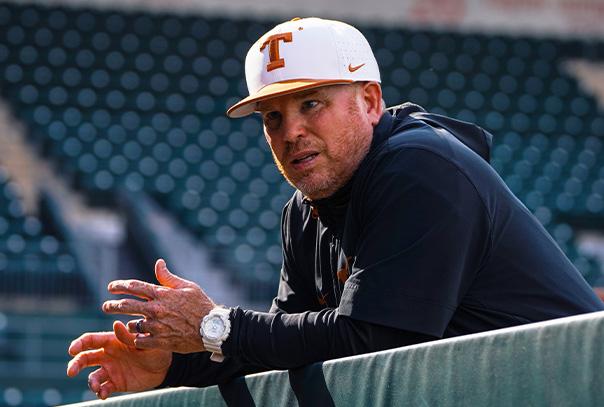
After amassing over 730 wins across a quarter-century as a head coach, Chuck Box joined Jim Schlossnagle’s Texas A&M staff in 2022 and stayed on for the move to the University of Texas in ’24. Box is a six-time MAIS Coach of the Year and owns a .692 career winning percentage. He arrived in College Station following a four-year stint as Head Coach at Hartfield Academy in Jackson, Mississippi, where he led the Hawks to a pair of state runner-up finishes. In his previous position, he led the Jackson Preparatory School to six state championships during a run in which they made ten consecutive playoff appearances.
Prior to his high school coaching career, Box coached his alma mater Freed-Hardeman to a conference championship and a No. 7 finish nationally, and led Itawamba Community College to a 148-57 record from 1998-2002, reaching the pinnacle in the NJCAA rankings during that stretch. He served as an assistant at Mississippi College and Freed-Hardeman in 1992 before his promotion to the head coaching position in 1993.
A native of Columbus, Mississippi, Box has been married to the former Amanda Edwards since 1990. The couple has a son, Trey, and two daughters, Isabelle and Hazel.
Inside Pitch: Tell us about your journey in coaching.
Chuck Box: I was fortunate to have good coaches in high school who impacted my life. Sammy Fletcher was my baseball coach, David Nelson and Tim Carter were my football coaches. So getting into that was something I had always thought about.
When I first went to college, however, I was in finance. I wanted to be a stockbroker, make a bunch of money, wear Armani suits and drive a Ferrari...but I was bad at math! I was just fooling myself; deep down inside, I think I always wanted to coach.
Because I was not a very good player and I got hurt, I was fortunate enough to become a student assistant coach my junior year at Freed-Hardeman University. That gave me such a great opportunity to really develop my ideas, philosophies, and systems and practice coaching.
IP: Did you always want to end up at a place like Texas?
CB: Growing up in Mississippi, I was in the middle of the Southeastern Conference, and around that time was when SEC baseball was really starting to grow. That is when I fell in love with college baseball. I became a college head coach at the age of 24 and have been fortunate to do something I love for the past 32 years, and when I was younger, being a head coach at a great college program was a dream. But as I got older, it became more about being somewhere where there is a commitment to excellence, somewhere that had the resources to be successful, somewhere where you could win the last game you coached in.
IP: What’s it like going from a head coach with 700+ wins to being an assistant?
CB: It has been great. It makes it easier because I am working for one of the best college coaches in college baseball, a hall of famer in Jim Schlossnagle. I believe the fact that I was a head coach for 25 years in some ways made it easier for me to adapt to the role of being an assistant coach. I believe having that head coach experience—albeit not at this level—helped me to better understand what Coach Schlossnagle is going through on a daily basis. I believe that experience allows me to better support him.
Being an assistant has several roles as it relates to the head coach. First and most importantly, you have to have loyalty. After that, I believe it’s about helping to bring the vision of the program to life by supporting the culture that the head coach envisions. For me that all boils down to a very simple concept, which is dedicating myself to being whatever my team needs on a daily basis. That role may change from year to year, week to week, and day to day. But at the end of the day it is simple for me. I just ask, “What do I need to be today to help our organization fulfill our mission?”
IP: What were the main takeaways you had going from an elite high school to an elite college? How did you personally adjust?
CB: That is a good question, and I think the number one thing is the pace. Not just in the game itself, of course the pitching, defense, and offense are accelerated, but the rhythm of the day and the year is much different. The pace in which information is processed, the pace of practice, training—that is the biggest difference in my opinion.
As far as the adjustment goes, it still comes down to relationships and playing winning baseball. Building relationships and trust with players is the same at any level. And the things that helped us win games in high school help us win here: playing catch, putting together quality at bats, running the bases intelligently and aggressively, and playing great situational baseball.
IP: What message would you relay to current high school players as a result of your experience?
CB: If you want to play college baseball, then I would ask, “What makes you intriguing to a college coach? What is your carrying tool? Why would they sign you?” I would also ask them, “What separates you from other players with the same height, weight, measurables? How do you handle failure?” To me those are great separators.
Find ways to make your training more game-like: add variety, risk being uncomfortable, redefine success in your training. An example of this is to hit higher-than-normal velocity off machines. Get out of your comfort zone!
I would also encourage them to really invest in mental training. That side is so critical. If you are not in control of yourself, then you cannot be in control of your performance. And lastly but certainly not least, I would tell them to get stronger. The college game is very physical, and the stronger players position themselves for better success. Rest and nutrition are big pieces of that too, all in an effort to “build a better engine!”
IP: What are some ways that you have been able to stay organized throughout your stops?
CB: At the beginning, organization to me was about survival. I did not have the resources that many of my competitors had when I first started coaching. So in my mind, one way I could get ahead was to be more prepared. I also did not have any full-time staff, so creating a system where I could “franchise” a drill was critical. When we’re doing that, we are creating drills that are clearly defined, easily understood, and can be used by different staff members or players with ease. My first year coaching, our junior centerfielder ran most of the positional drills in practice.
I really believe that sometimes people criticize the preparation/organization piece and equate it to rigidness and inflexibility, but to me it is the opposite. In my opinion being prepared/organized with your charts and spending a great deal of time planning makes it easier to be flexible and adjust.
IP: Are there any particular charts that you’ve used in the past that you have become staples of your program and would be at any level you coached?
CB: From a planning point of view, the Player Development Phased Calendar and the Weekly Planning Sheet have been staples for me. I also wore out the Defensive Positional Checklist and the Baserunning Checklist. Of course, the Practice and BP Plan sheets I used in high school and the Game Administration sheet are staples as well.