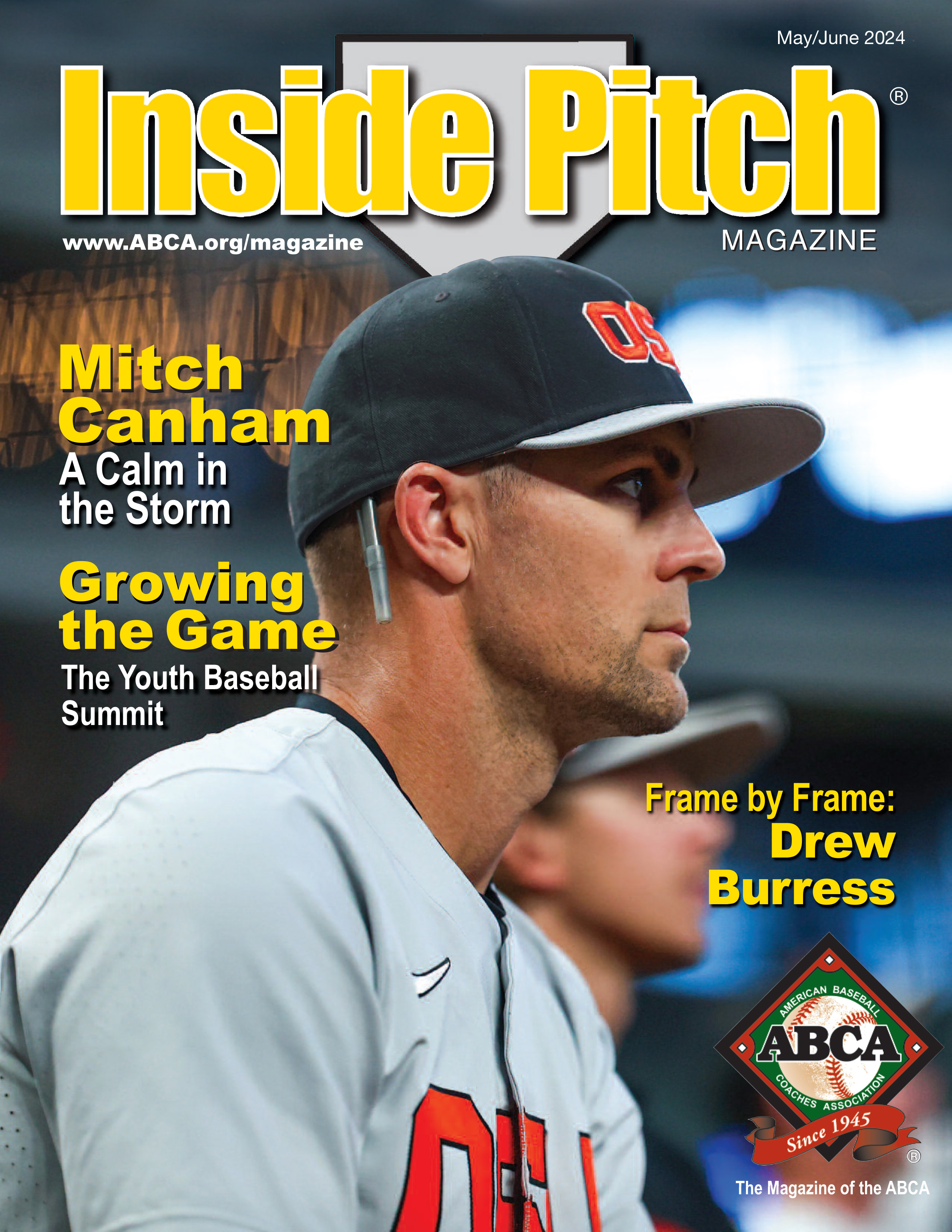
Two-time national champion Mitch Canham was named the head coach at Oregon State after the 2019 season. A former All-American as a player, he led the Beavers to three trips to the College World Series, including back-to-back titles in 2006 and 2007. He was also recognized as an Academic All-American and was selected 57th overall in the 2007 MLB Draft. He played at the Triple-A level for four different organizations.
A native of Richland, Wash., Canham returned to Corvallis after three-plus seasons as a manager in the Seattle Mariners’ organization. He has filled the legendary Pat Casey’s shoes admirably, as his teams have made postseason play in each of his first three seasons, eclipsing the 40-win mark in two of them and emerging as one of the best teams in the country in 2024.
Inside Pitch: How do you stay grounded when your team wins 30 of its first 35 games?
Mitch Canham: We talk about humility on a daily basis, and our focus has to stay in the present—win or lose, what are we going to do today to get better? The nonstop focus, the words you hear around the batting cage, on the bus, around our program have to be funnelling into that one concept: what are we doing to help one another?
IP: Talk about the impact a player like Travis Bazzana makes on your program.
MC: On his recruiting trip I saw him take pictures of our program records display in the player’s lounge. And everybody takes pictures of that, but you could tell he was doing it differently. We saw him play in Arizona and you see the video and it’s an instant “yes” in terms of the skills, but spotting talent is pretty easy, anybody can do that. Travis’ character is the separator for him, and it’s why we were so interested.
Because another thing Travis took pictures of was that empty spot we have next to the three titles in our trophy room. It’s something to set his sights on, to beat the records, to add that next title, “I want to help add another one here, too.” That’s how the guy goes about his day, and that’s how a lot of our guys go about their days. They’re aware and accountable for their actions but they are focused on the program, on each other. We all have to continue to get better every day and we have to push one another, and Travis helps us lead the way.
IP: How do you find that character in recruits who might not have as many standout skills/tools?
MC: I try to give them reasons not to come here and see how they respond. Let’s talk about the weather, it rains here. But guess what? It rains all over the place, it rains in the big leagues, and it’s cold all over the place. If they ask about gear, zero interest for me. You want to talk gear? We’re a tier-one Nike program, but in the fall, here’s a hat, here’s a shirt, here’s your pants, let’s go play. Don’t come here for the gear. After Christmas you’ll get your locker filled and all that fun stuff.
IP: You’ve clearly not been hesitant to talk about season-long goals as a team. How do you build and maintain that level of expectation?
MC: There’s that space we talked about in the trophy room. That’s where the next one goes and everyone knows it, but we also try to make it about the journey. As a freshman I remember sitting at my locker talking about goals, and I blurted out “I’m not interested in winning a series. I want to sweep. Why would we ever think about losing any games? I came here to win it all.”
That was part of a conversation I had with Darwin Barney in 2006 about whether we were going to sign. I told him, “I came here to be the first person in my family with a college degree, and to win a national championship.” And he’s like, “Well, anyone can win one.” I said, “That's right, I tell you what, I'll come back, but only if we win another one.”
IP: Everyone makes goals but very few can fulfill them like you all did…
MC: It’s just envisioning all these things, which I’m sure everyone does. And we still do a lot of mental skills exercises, but it really just comes down to putting that picture in your head of what you want and dedicating everything you have in going to get it, surrounding yourself with people who are like you and who are going to hold you accountable. That last part is the toughest, I’m sure. It really all comes back to our recruiting process; when we question recruits we are rigorous, we have to make sure we’re bringing in the right people. Do they understand how to handle adversity? What kind of motor do they have? How do you respond after you make an error? Do you turn to the pitcher and say, “I got you, get me another one,” or are you staring at your feet? How about after a teammate makes an error?
IP: When did you know you had something special going with the 2024 team?
MC: A week before our first game of the season, a large group of guys went out for hours dancing and carrying on, not unlike a lot of places, I guess. But our group was with Special Needs kids, which they had set up on their own. At practice the next day [Bazzana] comes up to me and tells me the lower halves are a few steps behind, and I say okay, why? He replies, “Dancing and karaoke” and proceeded to explain everything! How about that? These guys have a million things going on and they take time out of their day to pour into other people and they don’t seek recognition. They probably still don’t even want me saying anything.
Unless you are here and live it, I don’t think people understand how special it is and how much they’re missing by not being here. But there’s only a handful of guys that can fit in that clubhouse that we let in here and if you come back for alumni weekend, you can see it, you can feel it.
IP: That’s great. Anything else you do that promotes your team building?
MC: Oh yes, we take a week and go on a retreat before the fall. We went up to Canada for nine days recently and I gave them their phones in the evening for a half hour or so, but other than that, phones are mine. It’s wake up at five in the morning, go for a hike, go hit the gym, grab some good breakfast. And the relationships they build? You can see it after just a day or two. We try to start off every fall like that, taking a couple days to get away and doing some team bonding, before we even pick up a baseball.
IP: What was it like getting to coach for the team you grew up rooting for?
MC: I love the Seattle Mariners—I grew up in the area, so when I got to have a locker next to Dan Wilson and hang out with Ichiro and Edgar Martinez and Jay Buhner? How cool is that?
Watching the Mariners play every night kept me out of trouble as a kid. But I also told Andy McKay that I would always be a Mariner unless this one job [at Oregon State] comes along, and that I would give anything to be the head coach here. And when it opened up, Jerry DiPoto and Andy sent extra staff to come help out with our affiliate so I could focus on the interview process. They said “this is what you’ve always dreamed of. Give it everything you got.” I owe a lot to them and to the entire Mariners organization.
IP: You always seem to appear under control...what’s the secret to that?
MC: Preparation. I try to work out as many different situations as I can so that when they come up, I don’t make rash decisions. That was a nice thing about coaching in the minor leagues—in four years I got to manage over 500 games. So you learn to slow your heart rate down, how to see situations for what they are, you learn how to really plan ahead so when it’s the fifth inning, you’re already thinking about the seventh.
I had a kid come up to me not long ago and say, “I know who you are—you’re the coach of the Beavers. How come you’re not up on the top step yelling at people? You’re too calm. Coaches are supposed to watch the game closely and yell at people when they don’t do it right.” I had to laugh. But in all seriousness, I am pretty hard on everyone at practice, so when we play games we can be loose and let the prep take over.
IP: How do you separate that emotion as a coach when you played with so much of it?
MC: I know that everyone around me is going to be emotional, especially the players, so I try to keep emotion out of it as a manager or head coach. I try to just remind myself to just have an even-keel conversation throughout the game. I am positive that everyone who plays for us is out there trying to give their best, and mistakes happen.
People like to get excited about sports, and so do I. I know how the ’95 Mariners and the ’96 Sonics and the 2013 Seahawks made me feel. But when you’re in it, you’re trying to help these guys become the best version of themselves and sometimes you get fiery, but it’s about just learning who your guys are and knowing them better than anyone else does.
IP: What’s a practice staple for your clubs?
MC: My all-time favorite to put on the practice plan is 27 outs. You can run it a million different ways, but let’s go 27 in a row without missing a tag—all the way to the ground—no bobbles or short-hops. Or let’s put two teams out there and compete against each other. How crisp can we make it? If you mess it up, you go back to zero and start again. It’s definitely something you have to do early on in practice! But the earlier you get it done, the earlier you start BP, and everyone wants to hit BP.
Staying along those lines, we also chart ground balls in BP, love that. We track all of them. How many did you field? How many throws did you make? Plus or minus? What’s your fielding percentage? Did you get it done?
IP: So with all this technology around you, you’re still excited about the clipboard and a pencil…
MC: I like all the tech, I know how to use it, and we have a great team that provides a lot of information here for us. But absolutely, I love the simple stuff. I love eye contact. I love guys being able to get out there and communicate. I love hustling around. We create a lot of up/down situations and we have fun with it, mix in wiffle balls one day, stuff like that. We lock in on catch play, we don’t just sit around and waste that time.
Any time we scrimmage, I love putting runners all over the bases. The windup is too easy! “We're scrimmaging today? Good… bases loaded to start.”
Let’s see what we got, let’s instill some toughness in our pitchers, let’s work cuts and relays, let’s put pressure on hitters. “Can you get this guy in? Can you execute when it really matters?” Bases empty reps are fine, but they’re not going to help you win championships.
IP: Your family has faced a daunting amount of adversity. How has it shaped you as a coach?
MC: I was shaken when I lost my younger brother, and I still wear his dog tags every day as a reminder. And my mother couldn’t take care of my half-brother, who I never had a childhood with. But just a couple years ago, his wife Katie said, “do you want spend more time with your family?” He goes, “Yeah!” and after not being around each other for 30-something years, they moved here and both work at the Beaver Bookstore, which I am literally looking at here as I stand on our field. I know my brother’s over there, I know he’s gonna get off work at three, come by and watch practice, and hang out until he picks his wife up and they head home.
I grew up in a military family, so it was always about serving the greater good, “do your job” to the best of your ability, and when something is asked of you, take care of it, because it’s the right thing to do. So I grew up learning to care about people, about purpose, faith and how to surround yourself with people of similar values.
As the coach here, I just want to make this thing the best that it can possibly be. My vision is to enclose the stadium, endow all the coaches’ positions, leave a legacy. No one’s going to remember who I am in 100 years, right? So I want to leave this place in a better spot. My experiences have helped me do this to the best of my ability, and to do what’s right for the program and for Oregon State University.